
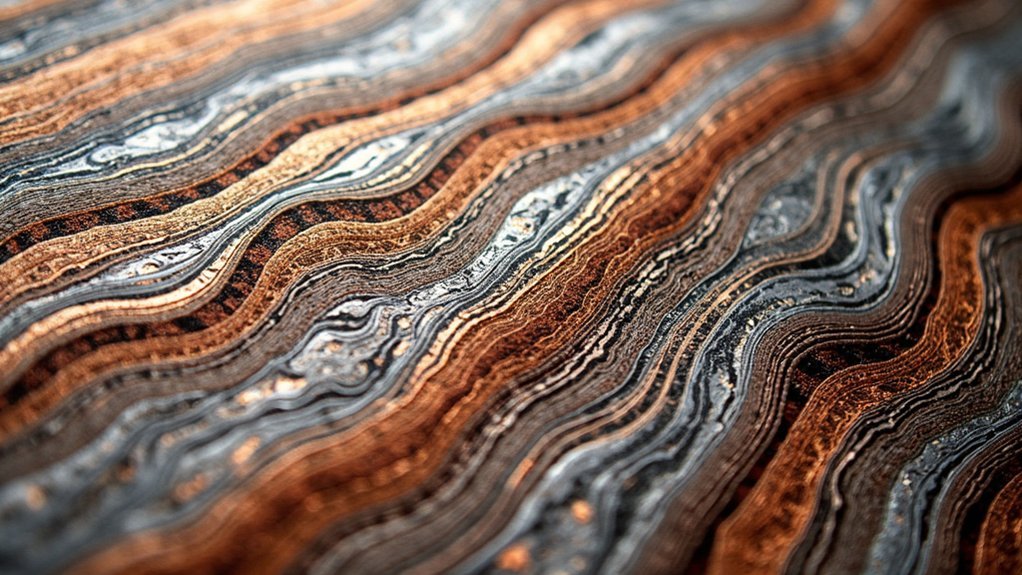
Mokume-gane is a 17th-century Japanese metalworking technique that translates to “wood grain metal.” You’ll create stunning layered patterns by stacking different metals like silver, gold, and copper in alternating layers, then fusing them through controlled heat and pressure. The bonded metals are manipulated through carving, drilling, or hammering to reveal intricate wood-like or geometric patterns. This ancient art form requires precise temperature control and surface preparation for successful atomic diffusion bonding between layers. Explore the detailed process to master this enchanting craft.
Origins and Historical Development of Mokume Gane
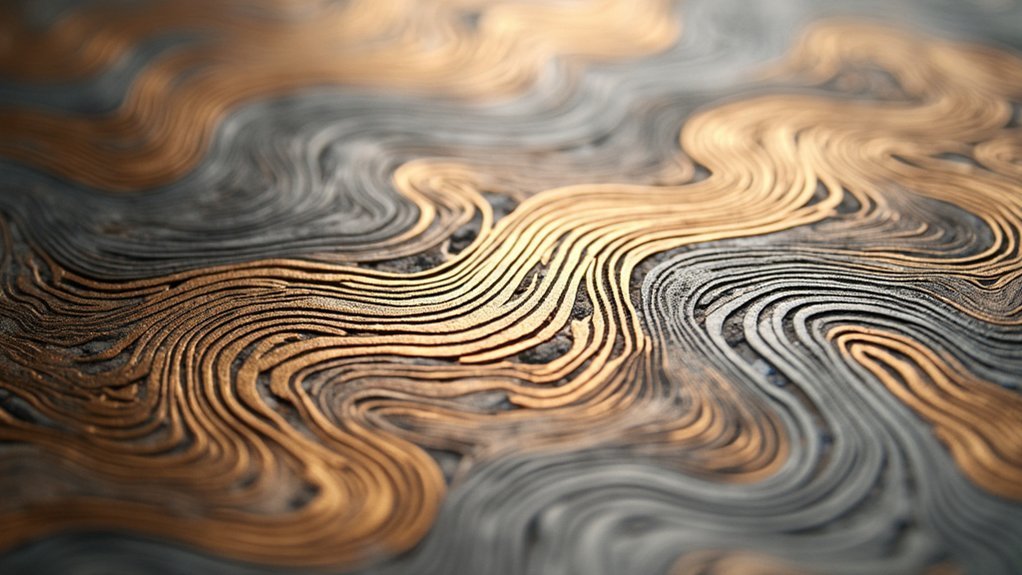
While Japan’s samurai class dominated the social hierarchy of 17th-century society, skilled metalworkers developed Mokume Gane as an innovative technique for creating ornamental sword fittings that reflected both artistry and status.
You’ll find that “mokume-gane” literally translates to “wood grain metal,” describing the distinctive layered patterns achieved by fusing different metals together. This traditional Japanese craft flourished as artisans perfected methods to create beautiful, wood-like textures in metalwork.
However, you’d witness a dramatic decline after the Meiji Restoration in the late 19th century. When authorities prohibited public sword display, skilled craftsmen found their primary market disappearing.
They adapted by applying their expertise to other decorative metalwork, ensuring this remarkable technique survived despite changing social conditions.
Understanding the Wood Grain Metal Technique
Beyond its poetic name, mokume-gane represents a sophisticated metallurgical process that transforms ordinary metals into extraordinary patterned materials.
You’ll create this wood grain metal by stacking small metal coupons—typically silver, gold, and copper—in alternating layers. Through controlled heat and pressure in a kiln, you’ll achieve atomic diffusion bonding without using lower melting temperature interlayers.
The magic happens when you manipulate these fused layers. You can twist, fold, or carve the bonded metal block to reveal stunning patterns that mimic natural wood grain, geometric designs, or even landscape-like formations.
Your success depends on mastering temperature control and understanding how different metals respond during the bonding process. Modern innovations have made mokume gane more predictable while preserving its artistic integrity.
Essential Metals and Materials for Layering
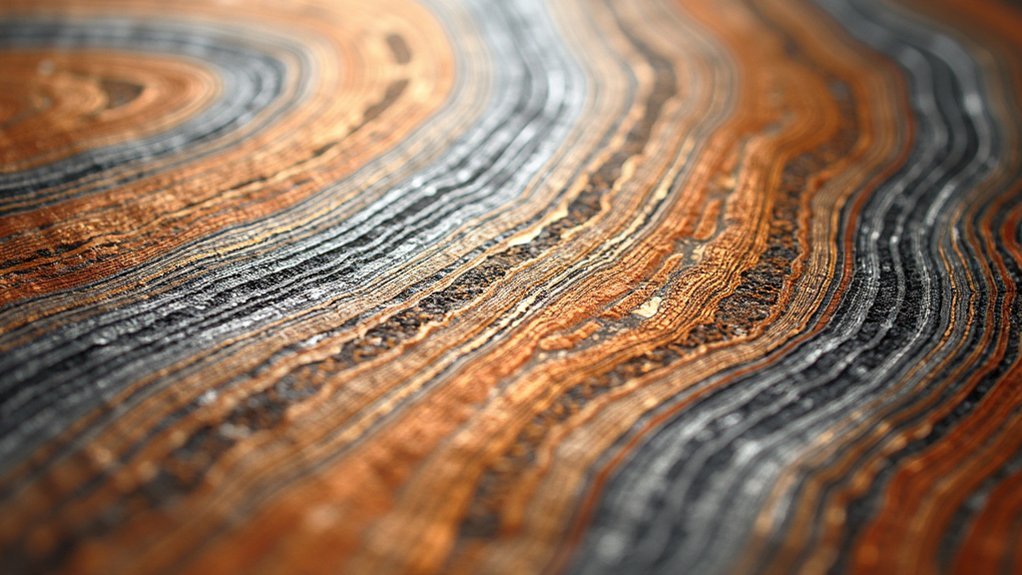
Although selecting the right metals determines your mokume-gane’s final appearance, you’ll need to contemplate both aesthetic and technical properties when choosing materials. Precious metals like sterling silver, fine silver, yellow gold, rose gold, and copper create the contrasting layers essential for achieving the distinctive wood grain pattern.
Metal selection for mokume-gane requires balancing aesthetic appeal with technical properties to achieve the signature contrasting wood grain pattern.
You should use metal sheets between 18 to 22 gauge thickness, which provides the perfect balance of flexibility for manipulation while maintaining structural strength.
Plan for a minimum of 12 layers to guarantee successful lamination—fewer layers won’t produce the dramatic visual effects mokume-gane is known for.
Surface preparation is absolutely critical. You must thoroughly clean each metal sheet before assembly, as any contamination will prevent proper bonding and compromise your final piece’s integrity.
Metal Preparation and Surface Treatment
You’ll need to thoroughly clean your metal surfaces before stacking, as any contaminants or oxides will prevent proper bonding during fusion.
Create slight abrasion on each surface using fine sandpaper or steel wool to give the metals better grip when they’re compressed together.
Apply flux or use an inert atmosphere during heating to prevent oxidation that could weaken your mokume-gane bonds.
Cleaning Metal Surfaces
Since successful mokume-gane requires pristine metal surfaces, you’ll need to thoroughly clean each piece before beginning the lamination process. Remove all oxides, oils, and contaminants that could prevent proper bonding between layers.
Start by abrading the edges of each metal coupon using fine sandpaper or steel wool to enhance adhesion. This roughened surface creates better mechanical bonding during lamination.
After abrading, degrease the surfaces using acetone or alcohol to eliminate fingerprints and manufacturing residues.
Apply a thin layer of ground pumice to prevent sticking during pressing while maintaining distinct layers.
Don’t forget to use flux along the edges during heating—it’ll prevent oxidation and guarantee cleaner, stronger bonds throughout your mokume-gane piece.
Abrasion for Bonding
Proper abrasion creates the foundation for strong mokume-gane bonds by establishing ideal surface conditions for atomic migration.
You’ll need to carefully prepare each metal coupon’s surface before assembly to guarantee peak adhesion between layers.
Here’s your step-by-step abrasion process:
- Remove oxides and contaminants – Sandblast or use a grinding wheel to eliminate surface impurities that prevent proper bonding.
- Create uniform roughness – Achieve consistent texture across all metal surfaces to promote mechanical adhesion.
- Apply ground pumice – Dust layers during the stack assembly to prevent premature sticking and enable easier handling.
- Verify cleanliness – Inspect surfaces for residual dirt or oils that could compromise bond strength.
Thorough abrasion enhances atomic migration during heating, guaranteeing your finished mokume-gane exhibits superior structural integrity throughout the diffusion bonding process.
Preventing Oxidation Methods
While surface preparation establishes the foundation for bonding, preventing oxidation during the heating process proves equally critical for achieving flawless mokume-gane results. You’ll need to implement multiple protective strategies to maintain clean metal surfaces throughout fabrication.
| Method | Application | Purpose |
|---|---|---|
| Flux application | Edge sealing | Blocks oxygen exposure |
| Controlled atmosphere | Kiln environment | Reduces atmospheric oxygen |
| Ground pumice | Surface treatment | Prevents layer sticking |
| Chemical cleaning | Pre-stacking preparation | Removes oxides completely |
| Mechanical abrasion | Surface preparation | Eliminates contaminants |
Proper cleaning guarantees you’re starting with oxide-free metals, while flux creates protective barriers during heating. You can also use controlled kiln atmospheres to minimize oxidation exposure. These combined approaches ensure successful layer bonding without compromising metal integrity.
Stacking and Compression Methods
You’ll need to stack your metal sheets with precision, ensuring each layer fits flush against the next for ideal bonding.
Once you’ve assembled at least 12 alternating layers of your chosen metals, you’ll apply consistent pressure using a hydraulic press set to approximately 20 tons.
This compression stage is critical—you’re creating the foundation for a solid billet that will fuse properly during the heating process.
Metal Sheet Preparation
Before you can begin the fusion process, each metal sheet requires thorough cleaning to remove any oxides, oils, or contaminants that would prevent proper bonding.
This metal sheet preparation is absolutely critical for successful mokume-gane creation. You’ll need to meticulously prepare each surface before moving into the stacking process.
Here’s your essential preparation checklist:
- Clean thoroughly – Remove all oxides and contaminants from metal surfaces
- Trim edges precisely – Cut each sheet for flush alignment during stacking
- Use proper gauge – Select 18-22 gauge metal sheets for ideal results
- Prepare torque plates – Coat with yellow ochre or white out to prevent sticking
Once you’ve completed these steps, you’re ready to stack your alternating metal layers and apply pressure using a 20-ton hydraulic press for proper compression.
Hydraulic Press Techniques
Stack your prepared metal coupons in alternating layers, creating a billet that will become the foundation of your mokume-gane piece.
During this stacking process, you’ll arrange small squares of different metals like silver, gold, and copper in a specific sequence. Apply ground pumice to each surface before stacking to prevent the layers from sticking together inappropriately during compression.
Once you’ve completed the stack, place it into your 20-ton hydraulic press.
The hydraulic press applies even pressure across the entire surface, compressing your metal coupons into a solid block. This compression is essential because it creates the initial bonding between layers and prepares the billet for the heating phase.
The hydraulic press guarantees uniform pressure distribution, which prevents warping or uneven fusion that could compromise your final mokume-gane patterns.
Bonding Processes: Heat and Pressure Application
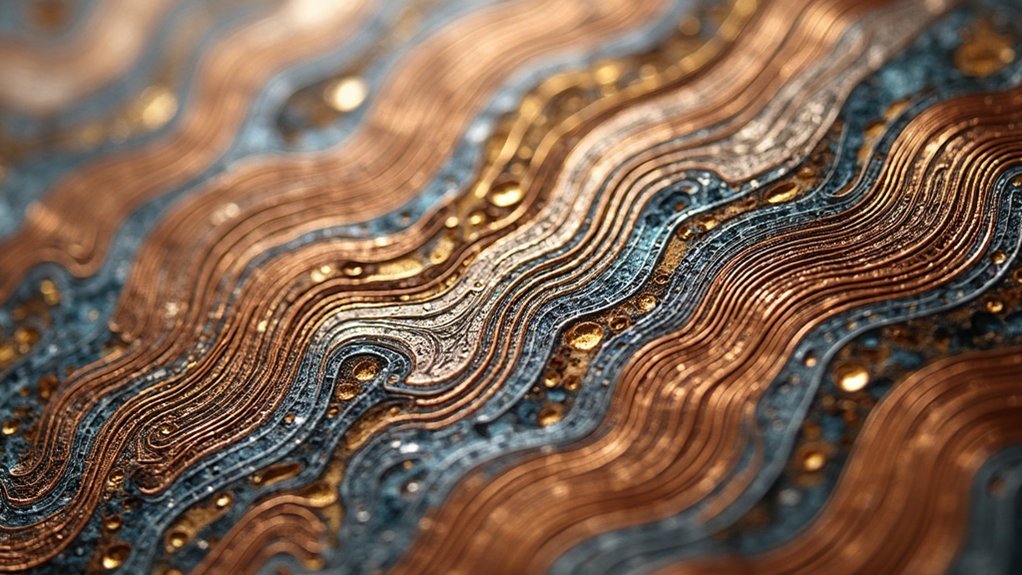
Although mokume-gane’s visual appeal captures most attention, the bonding processes that create this layered metal art form require precise heat and pressure application to achieve successful fusion.
You’ll encounter two primary methods that transform separate metal sheets into bonded mokume through controlled thermal and mechanical forces.
The critical factors for successful heat and pressure application include:
- Temperature Control – Maintaining consistent heat below melting points for liquid phase diffusion bonding
- Pressure Distribution – Ensuring uniform compression across all metal layers using hydraulic presses
- Environmental Management – Creating clean, controlled conditions to prevent contamination during atomic exchange
- Timing Precision – Coordinating heat and pressure cycles to achieve ideal metal fusion without defects
Modern techniques have revolutionized traditional methods, replacing basic forge welding with sophisticated kiln and press combinations.
Pattern Development Through Carving and Manipulation
Once you’ve successfully bonded your metal layers through heat and pressure application, the real artistry begins with pattern development through carving and manipulation.
You’ll use two primary techniques to reveal the contrasting colored layers beneath: bumping/chasing and carving.
For bumping/chasing, you’ll roll your metal to 16-18 gauge, then use punches to create strategic bumps. These bumps are later ground away, exposing beautiful patterns underneath.
With carving, you’ll thin your metal to 8-10 gauge and anchor it securely.
Using a flex shaft, you’ll begin initial carving work, then drill concentric ring patterns. For best results, drill only through the first three layers to maintain design integrity while revealing desired patterns.
Modern Vs Traditional Mokume Gane Approaches

You’ll find that traditional Japanese fusion methods require mastering high-temperature techniques where you manually control heat to create local alloying between metal layers.
Modern approaches let you use hydraulic presses and controlled kilns that deliver consistent results with greater precision than hand-forging methods.
Contemporary bonding techniques also expand your material options beyond traditional metals, allowing experimentation with titanium and platinum that wasn’t possible with historical methods.
Traditional Japanese Fusion Methods
When examining traditional Japanese fusion methods, you’ll discover that master craftsmen relied entirely on their intuitive understanding of temperature control and timing to achieve the critical bonding between metal layers.
These artisans perfected solid state diffusion bonding through centuries of practice, creating stunning patterns that would later reveal distinctive metal or wood eye designs.
Traditional Japanese techniques emphasized four core principles:
- Temperature mastery – Achieving precise heat without modern instrumentation
- Layer preparation – Meticulous cleaning and stacking of precious metal sheets
- Forge welding – Using hammer and anvil to compress heated layers
- Pattern development – Carving and folding to create unique designs
You’ll find that these methods required exceptional skill, as craftsmen had no mechanical aids or controlled environments to guarantee consistent results.
Contemporary Bonding Techniques
While traditional artisans mastered mokume-gane through intuitive heat control and manual forge welding, modern craftsmen now harness advanced diffusion bonding techniques that deliver unprecedented precision and consistency.
You’ll find liquid phase diffusion bonding particularly effective, as it creates atomic exchange between metals without requiring lower melting temperature interlayers. This method allows you to achieve superior bonding while maintaining better control over the process.
Solid state diffusion bonding offers another contemporary approach, operating below melting points through controlled atomic exchange that forms new metal crystals.
You’ll need clean environments and specialized equipment, but the results are remarkably predictable. Modern kiln technology makes these advanced bonding methods economically viable, letting you produce consistent mokume-gane patterns while avoiding traditional challenges like gas entrapment and unpredictable fusion outcomes.
Patina Application and Color Enhancement Techniques
Although mokume-gane’s natural beauty captivates on its own, patina application transforms the piece into a truly spectacular display of contrasting metals and vibrant colors.
This enhancement technique dramatically increases the contrast between layered metals, making your mokume ring’s unique pattern more pronounced and visually striking.
The traditional niiro process utilizes rokushō as the primary patination agent to achieve stunning color variations across the metal surface.
Here’s how you can master patina application:
- Surface preparation: Use ground daikon radish paste to clean and prepare the mokume-gane surface for ideal patina adherence.
- Temperature control: Apply boiling solutions to transform specific metal elements and create vibrant results.
- Even application: Guarantee uniform coverage for consistent color development.
- Protective benefits: Gain tarnish resistance and oxidation protection alongside enhanced aesthetics.
Contemporary Applications in Jewelry and Metalwork
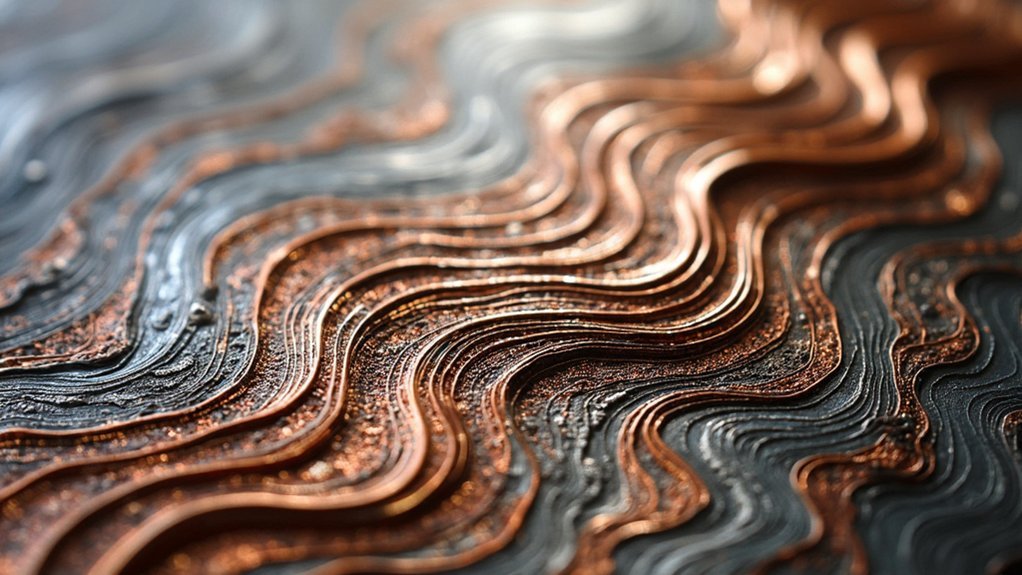
Modern artisans have transformed mokume gane from its traditional samurai sword origins into a cornerstone of contemporary jewelry design and metalwork.
You’ll find this wood-grain metal technique prominently featured in wedding rings, where jewelers fuse gold, silver, and copper to create unique patterns that symbolize individual love stories.
Contemporary jewelry makers like Green Lake Jewelry Works emphasize the handcrafted nature, ensuring each piece reflects personal meaning.
Handcrafted mokume gane pieces carry deep personal significance, with each unique pattern telling an individual story through metalwork artistry.
Advanced methods including diffusion bonding and liquid phase bonding have revolutionized production efficiency while maintaining artistic integrity.
You’ll discover mokume gane’s versatility extends beyond jewelry into artistic objects, knives, and flatware.
This resurgence showcases the technique’s adaptability, allowing you to own one-of-a-kind pieces that demonstrate intricate color variations and patterns impossible to replicate exactly.
Frequently Asked Questions
What Metals Are Used in Mokume Gane?
You’ll typically use contrasting precious metals like yellow gold, rose gold, silver, and copper in mokume gane. You can also incorporate modern materials like titanium and platinum for added variety.
What Is the Difference Between Damascus and Mokume Gane?
You’ll find Damascus steel uses carbon steel and iron for weapons, emphasizing strength through folding and hammering, while mokume gane layers precious metals like gold and silver for decorative purposes.
Why Is Mokume Gane so Expensive?
You’re paying for precious metals like gold and silver, plus the labor-intensive handcrafting process that requires specialized equipment and rare artisan skills that few craftspeople possess today.
What Is Mokume Steel?
You’ll find mokume steel isn’t actually steel but a Japanese metalworking technique that fuses different colored metals like gold, silver, and copper into layered composites, creating distinctive wood grain-like patterns through compression and heating.
In Summary
You’ve discovered a centuries-old Japanese metalworking art that transforms simple metal sheets into stunning wood-grain patterns. Through careful layering, compression, and manipulation, you can create unique pieces that blend traditional craftsmanship with modern innovation. Whether you’re crafting jewelry or decorative objects, mokume gane offers endless creative possibilities. Master the techniques of metal preparation, pattern development, and patina application, and you’ll reveal an artistic medium that’s both technically challenging and visually rewarding.


Leave a Reply