
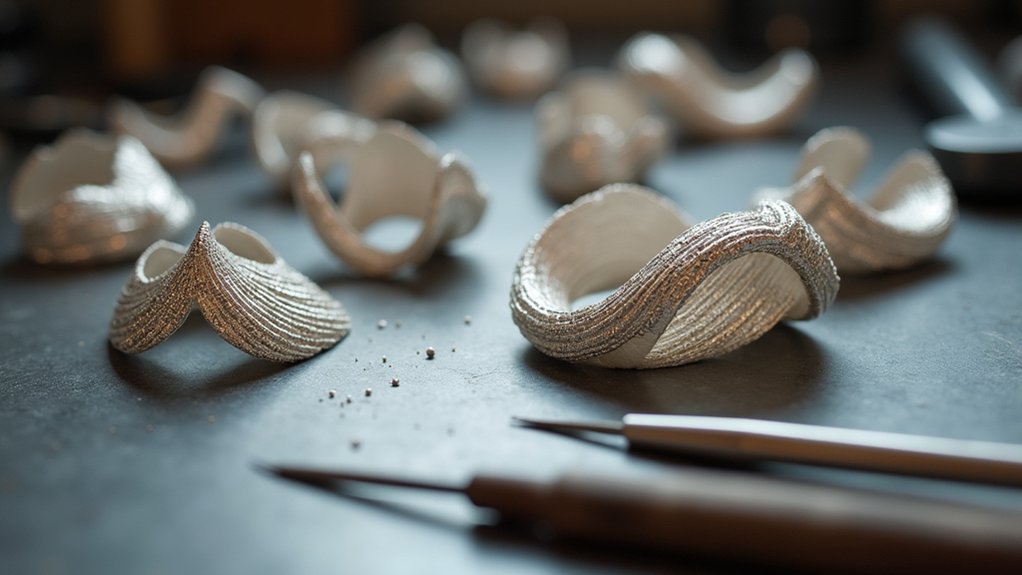
You’ll discover that silver fold forming is a revolutionary metalworking technique that transforms flat silver sheets into stunning three-dimensional jewelry through strategic folding, hammering, and heat manipulation. Developed by Charles Lewton-Brain in the mid-1980s, this method eliminates complex tooling while creating lightweight yet durable pieces with unique textures and organic shapes. You can craft earrings, pendants, and rings using basic tools like hammers, anvils, and torches. This exploration will reveal advanced techniques and creative possibilities.
The Origins and Development of Fold Forming Techniques
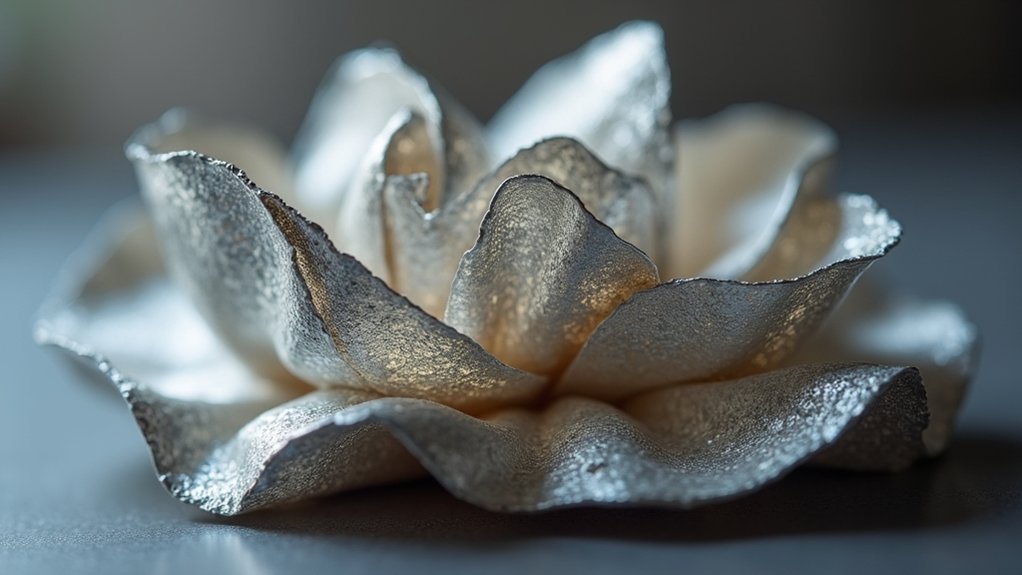
While traditional metalworking techniques required extensive tooling and complex joining methods, Charles Lewton-Brain’s revolutionary fold forming approach changed everything in the mid-1980s.
Charles Lewton-Brain’s fold forming technique revolutionized metalworking in the mid-1980s by eliminating complex tooling and joining methods.
You’ll find that this technique eliminates soldering needs entirely, allowing you to shape sheet metal through strategic folding patterns. The British Museum Research Lab recognized fold forming as a groundbreaking metalworking innovation due to its unique results and approach.
You can now harness metal’s natural plasticity, ductility, and elasticity to create complex three-dimensional shapes rapidly. Techniques like T-folds and pleated folds let you craft intricate designs within minutes using basic tools such as hammers and rolling mills.
Since its development, fold forming has become widely taught in schools and workshops, with thousands of practitioners adopting this transformative method.
Essential Tools and Equipment for Silver Fold Forming
Since fold forming relies on strategic metal manipulation rather than complex machinery, you’ll need only a handful of fundamental tools to begin creating sophisticated silver jewelry.
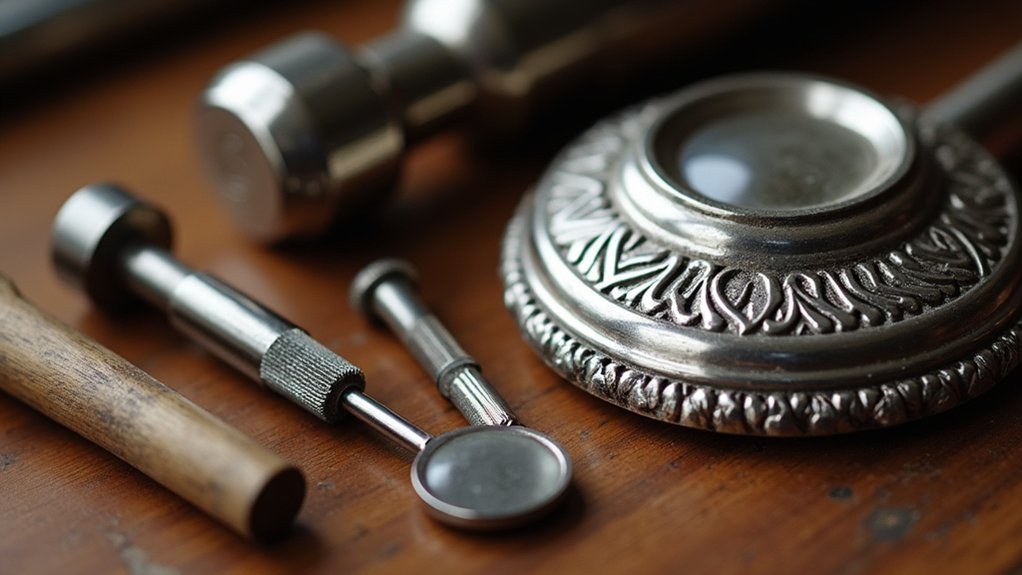
Your essential toolkit includes hammers, mallets, and anvils for shaping metal through controlled force. A rolling mill becomes invaluable for achieving uniform thickness across folded sections, as its parallel steel cylinders effectively stretch areas containing multiple layers.
For more complex work, you’ll want a hydraulic press to create intricate folds and properly deform T-folds.
Specialized hammers like riveting hammers and chasing punches allow you to add textures and confirm fold placement. Planishing hammers prove particularly useful for creating distinct work-hardened bands that enhance both the visual appeal and structural strength of your finished pieces.
Understanding Metal Properties in Fold Forming Applications
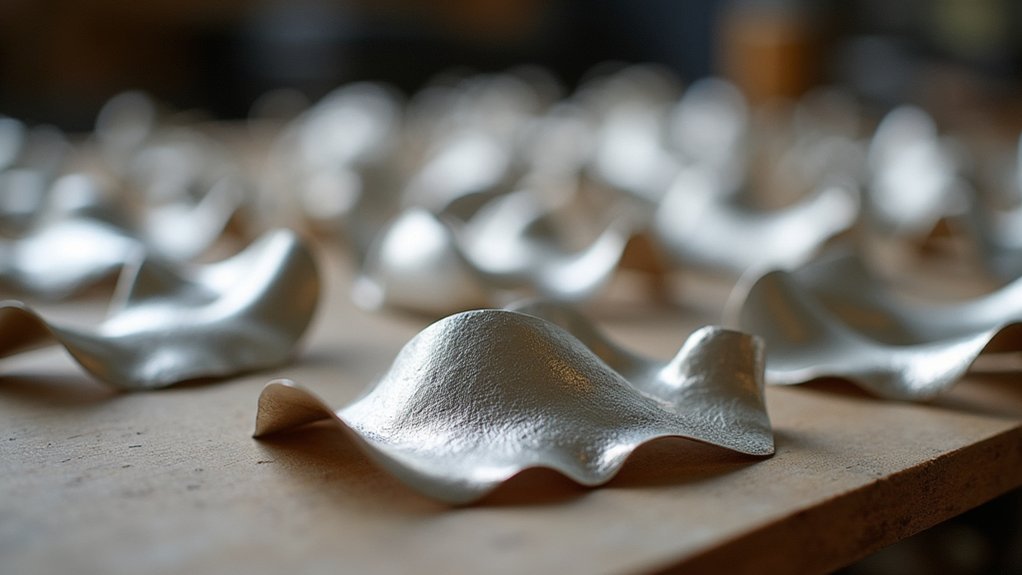
You’ll find that silver’s exceptional ductility and plasticity make it the perfect candidate for fold forming, allowing you to create complex shapes without cracking or tearing.
As you work the metal, you’ll notice it hardens quickly under manipulation, which means you’ll need to anneal frequently to maintain its workability.
Understanding how these properties interact during your fold forming process will determine whether you achieve those spectacular organic volumes or end up with brittle, unworkable metal.
Metal Ductility and Plasticity
Success in fold forming hinges on understanding how silver responds to manipulation. Sterling silver’s exceptional ductility allows you to stretch and bend the metal without cracking, making it ideal for creating intricate folded designs. Its plasticity guarantees that once you’ve shaped the metal, it retains those forms permanently.
Key factors affecting your fold forming success include:
- Temperature control – Heat affects how easily silver deforms
- Alloy composition – Sterling silver’s copper content enhances workability
- Work hardening – Repeated manipulation strengthens the metal
- Previous processing – The metal’s history impacts its current properties
You’ll find that understanding these properties lets you predict how your silver will behave during folding. This knowledge helps you achieve consistent results and prevents costly mistakes when creating complex three-dimensional jewelry pieces.
Work Hardening Effects
Work hardening transforms your silver’s behavior dramatically as you fold and manipulate the metal repeatedly. Each strike and fold compresses the crystalline structure, increasing dislocations that strengthen your silver while making it more resistant to further shaping.
You’ll notice this gradual stiffening as you continue working, which can be both beneficial and challenging for your designs.
Understanding work hardening effects is essential for successful fold forming. While sterling silver’s fluidity allows spectacular volumes in your pieces, overworking leads to brittleness and potential cracking.
You’ll need frequent annealing to restore malleability, especially when working with 18K yellow gold, which hardens quickly.
Monitor your metal’s response carefully – recognizing when to anneal prevents damage and maintains the structural integrity necessary for complex fold formed jewelry.
Basic Line-Fold Creation and Confirmation Methods
You’ll begin your line-fold creation by folding a sheet of silver over itself to establish a clear crease. Then use a mallet to tighten the fold edge for precision.
After tightening, unfold the sheet and prepare for the confirming process, where you’ll hammer the raised line to create a dense, structured basic line-fold.
This fundamental technique forms the foundation for more complex fold-forming patterns in your silver jewelry designs.
Folding and Malleting Steps
Start your line-fold by placing the silver sheet on a clean, flat surface and folding it over itself to establish a sharp, defined crease that’ll serve as your fold edge.
Once you’ve folded the metal, you’ll need to strengthen and refine the fold through systematic malleting:
- Strike the fold edge – Use controlled mallet blows along the entire fold line to tighten and compress the metal.
- Create consistent pressure – Maintain even force distribution to guarantee uniform fold quality throughout.
- Work methodically – Move systematically along the fold edge, overlapping strikes slightly for complete coverage.
- Check alignment – Verify the fold remains straight and properly positioned during the malleting process.
This malleting process transforms your initial crease into a structurally sound fold that’ll withstand subsequent forming operations and maintain its integrity.
Confirming Raised Lines
After completing your malleting work, the next step involves confirming the raised lines to transform your preliminary fold into a defined structural element. Confirming raised lines requires hammering the fold edge to enhance density and create pronounced basic line-folds.
You’ll achieve greater structural integrity by using rolling mills during confirmation, ensuring uniform raised lines across your metal sheet.
During the confirmation phase, you can employ scoring and bending techniques to produce curved line-folds for varied aesthetic effects. Adding texture becomes possible through rivets or chasing punches, which enrich the visual appeal along your raised lines.
This confirmation process solidifies your fold’s structure while opening creative possibilities for further manipulation and enhancement of your silver fold forming jewelry piece.
Advanced Line-Fold Variations and Texturing Techniques
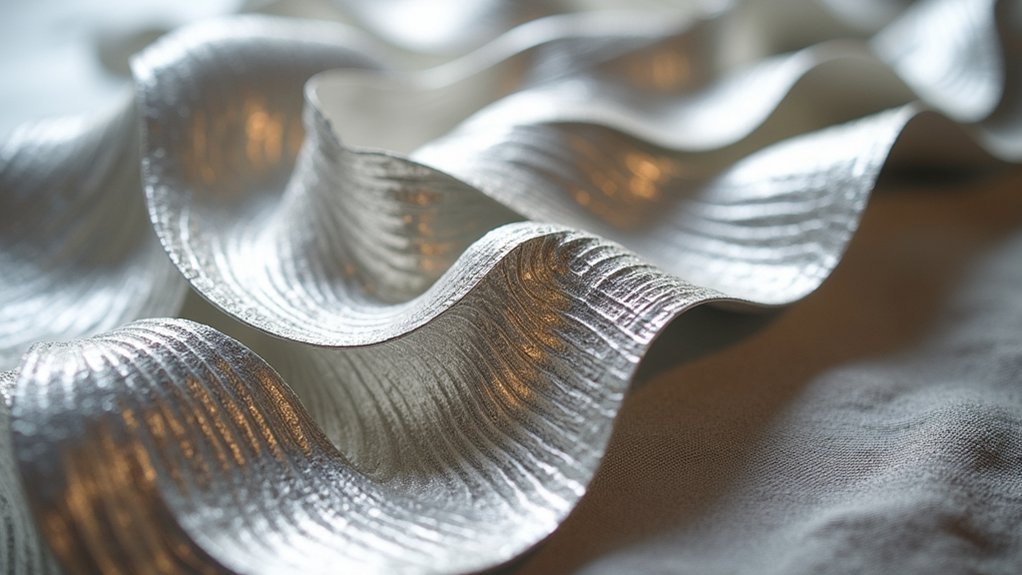
While basic line-folds create simple raised ridges, advanced variations release dramatic sculptural possibilities through double lines, parallel placements, and sophisticated texturing methods.
You’ll discover that texturing techniques dramatically enhance your fold forms’ visual richness by varying line heights and applying specialized tools during the confirmation process.
Here’s how to elevate your work:
- Create double lines and parallel or oblique placements for complex geometric patterns
- Apply riveting hammers and chasing punches during confirmation to develop unique surface textures
- Anneal between each folding stage to maintain metal integrity and enable easier manipulation
- Develop reflected line folds by folding metal over itself for striking mirrored patterns
These advanced techniques transform simple folds into intricate work-hardened bands with sophisticated textures, allowing you to create jewelry pieces with exceptional depth and visual complexity.
Rolled Fold Processes and Three-Dimensional Shaping
The rolled fold technique transforms flat silver sheets into dynamic three-dimensional forms by strategically folding the metal before passing it through a rolling mill’s parallel steel cylinders.
Strategic folding followed by rolling mill compression creates sculptural silver forms with enhanced dimensionality and structural integrity.
You’ll discover that areas with multiple layers stretch differently than single-layer sections, creating organic, flowing lines that enhance your piece’s dimensional quality.
This rolled fold process greatly increases your jewelry’s structural strength compared to flat sheets of equivalent thickness and area.
Silver’s natural fluidity allows you to achieve spectacular volumes and lightweight forms that capture visual interest.
Each piece you create becomes unique since slight variations occur during folding and rolling, ensuring your jewelry remains one-of-a-kind with distinctive characteristics that can’t be replicated exactly.
T-Folds and Cross-Fold Pattern Development
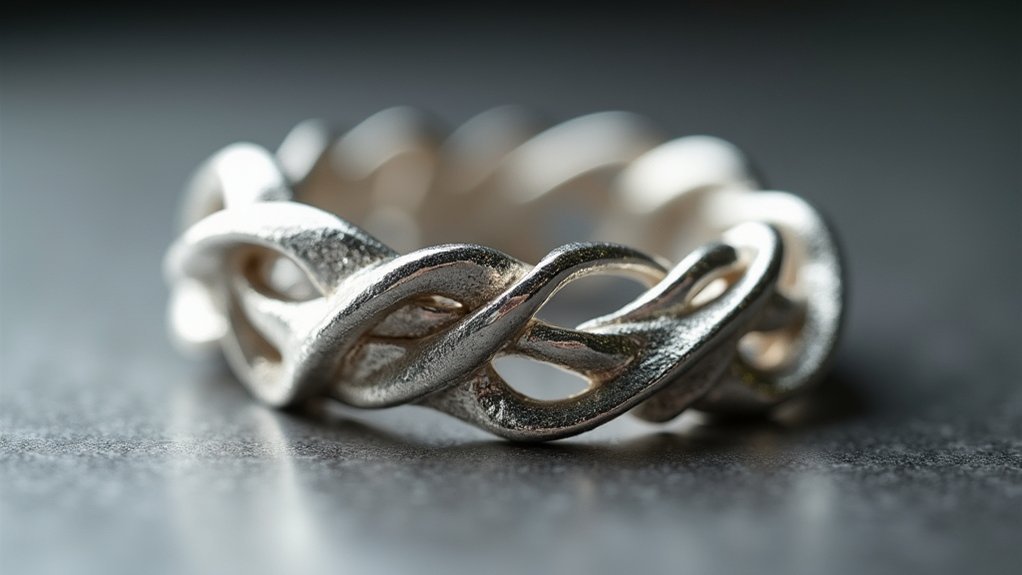
When you master T-folds and cross-fold patterns, you’ll unfasten advanced dimensional possibilities that surpass basic rolled fold techniques.
These sophisticated methods transform flat silver into sculptural elements with remarkable depth and character.
T-folds create distinctive “T” shaped configurations that you can manipulate into complex three-dimensional forms.
You’ll discover how these folds naturally enhance your jewelry’s structural foundation while adding striking visual elements.
Cross-fold patterns offer even greater complexity through multi-directional folding:
- Create intricate geometric patterns that catch light beautifully
- Develop organic textures reflecting metal’s natural fluidity
- Build enhanced structural integrity through compressed layers
- Generate unique tactile qualities for personalized designs
You’ll often use your rolling mill after folding to compress and confirm these patterns, ensuring uniform textures throughout your piece while maintaining the metal’s inherent strength characteristics.
Working With Different Silver Alloys and Gauges
You’ll find that sterling silver’s 92.5% silver composition creates the ideal balance of workability and strength for most fold forming projects.
When selecting gauge thickness, remember that higher numbers mean thinner sheets that produce delicate, intricate folds, while lower gauge numbers create robust structural forms.
Different silver alloys perform uniquely during folding—pure silver stays softer and more forgiving, while sterling’s copper content adds durability but requires more careful annealing management.
Sterling Silver Properties
Mastery of sterling silver’s unique characteristics forms the foundation of successful fold forming techniques.
You’ll find that sterling silver’s 92.5% silver and 7.5% copper composition creates an ideal balance between beauty and functionality for folded metal projects.
Understanding these key properties will enhance your fold forming success:
- Workability – The alloy maintains its shape under manipulation while allowing intricate designs
- Work hardening – Regular annealing restores malleability after significant deformation
- Ductility – Enables creation of complex, three-dimensional shapes that retain form
- Elastic behavior – Allows the metal to spring back while holding intentional folds
When you’re working with sterling silver, you’ll appreciate how its unique combination of strength and flexibility makes it superior to pure silver for structural folded metal pieces that require both durability and artistic expression.
Gauge Selection Guidelines
Three fundamental factors determine your fold forming success: gauge thickness, alloy composition, and intended design complexity. Your gauge selection directly impacts both workability and durability, with 18-24 gauge sterling silver offering ideal balance for most projects.
| Gauge | Thickness | Best Use | Strength | Workability |
|---|---|---|---|---|
| 18 | Thickest | Structural pieces | High | Moderate |
| 20 | Medium-thick | Heavy jewelry | Good | Good |
| 22 | Medium-thin | General forming | Moderate | Excellent |
| 24 | Thinnest | Delicate details | Low | Superior |
Thicker gauges provide structural integrity for substantial pieces, while thinner options excel in intricate detailing. Sterling silver’s 92.5% silver content guarantees excellent ductility across all gauges. Remember to anneal regularly, especially with heavier gauges, maintaining malleability throughout your folding process and preventing stress fractures.
Alloy Performance Differences
While gauge selection provides the foundation for successful fold forming, the specific alloy you choose dramatically affects how your silver responds to folding, annealing, and shaping processes.
Understanding alloy performance differences helps you achieve better results and avoid frustrating setbacks during your projects.
Different silver alloys exhibit distinct characteristics that impact your fold forming experience:
- Sterling silver (92.5%) flows beautifully during shaping and creates spectacular volumes, making it the preferred choice for most fold forming applications.
- Fine silver (99.9%) offers exceptional malleability but lacks the structural strength needed for complex designs.
- Argentium silver provides tarnish resistance while maintaining good workability, though it behaves differently than traditional sterling during annealing.
- Coin silver (90%) delivers increased durability but requires more aggressive annealing cycles to maintain workability throughout the folding process.
Troubleshooting Common Fold Forming Challenges
Why do even experienced metalsmiths encounter frustrating setbacks when fold forming silver jewelry? You’ll face common challenges that can derail your project, but understanding these issues helps you troubleshoot effectively.
| Challenge | Solution |
|---|---|
| Inconsistent fold depth | Careful annealing between each fold |
| Metal cracking during manipulation | Restore ductility through proper annealing |
| Uneven textures and distortion | Use rolling mill to confirm folds uniformly |
When you encounter resistance while folding, don’t force it—anneal the metal instead. You’ll find that proper tooling, including the right hammers and stakes, greatly improves fold quality and reduces errors. Observing and adjusting your folding angle and technique helps maintain consistent results. Remember, each fold should build upon the previous one systematically.
Creative Applications in Contemporary Jewelry Design
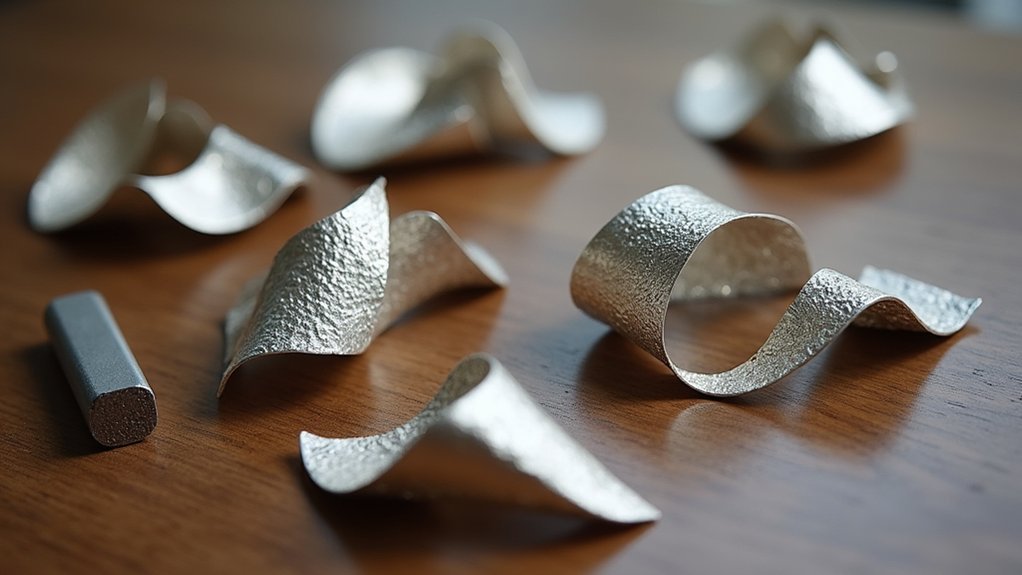
As contemporary jewelry designers push creative boundaries, fold forming silver transforms traditional metalsmithing into sculptural artistry.
You’ll discover that silver fold forming opens limitless creative possibilities in modern jewelry design.
- Organic-inspired pieces – T-folds and pleated techniques let you create nature-based forms that flow like leaves, waves, or flower petals.
- Minimalist elegance – Simple fold patterns produce clean, geometric designs that emphasize silver’s natural beauty and reflective properties.
- Complex layered structures – Multiple folding sequences build intricate, dimensional pieces that appear delicate yet remain structurally sound.
- Textural experimentation – Combining fold forming with hammering, patination, or surface treatments creates unique finishes and visual depth.
You’ll achieve the perfect balance between aesthetic appeal and wearability, crafting lightweight yet durable pieces that function as both jewelry and wearable sculpture.
Frequently Asked Questions
What Is Fold Forming in Jewelry?
You’ll fold metal sheets and manipulate them with hammers and rolling mills to create three-dimensional jewelry forms. This technique doesn’t require soldering, instead using metal’s natural plasticity to achieve strong, organic-looking designs.
What Is the Best Silver for Jewelry Making?
You’ll find sterling silver works best for most jewelry making since it’s 92.5% pure silver with added copper for strength. It’s durable, affordable, and strikes the perfect balance between workability and longevity.
What Is Silver Tone Metal in Jewelry?
You’ll find silver tone metal in jewelry that’s made from base metals like brass or aluminum with silver-colored plating. It’s affordable, mimics silver’s appearance, but doesn’t contain actual silver content.
What Is One Working Property of Silver That Makes It Suitable for Jewellery?
You’ll find silver’s exceptional malleability makes it perfect for jewelry creation. You can easily hammer, bend, and shape silver into intricate designs without cracking or breaking, allowing you to craft detailed, complex pieces effortlessly.
In Summary
You’ve discovered a transformative technique that’ll revolutionize your jewelry making. Silver fold forming isn’t just about creating texture—it’s about understanding how metal moves, stretches, and responds to your touch. You’ll find endless possibilities as you master each fold type and explore different alloys. Don’t let initial challenges discourage you; they’re stepping stones to creating unique, sculptural pieces that showcase your artistic vision and technical skill.


Leave a Reply